November 12th, 2026
Relevance in tech: Adding an optical path to the transport layer
Modern military systems increasingly depend on continuous data exchange between sensors, processing systems and operators. Under contested, Denied, Degraded, Intermittent and Limited (DDIL) conditions, however, conventional communication paths such as tactical RF, Wi-Fi, cellular networks and SATCOM may become degraded, congested, jammed or unavailable.
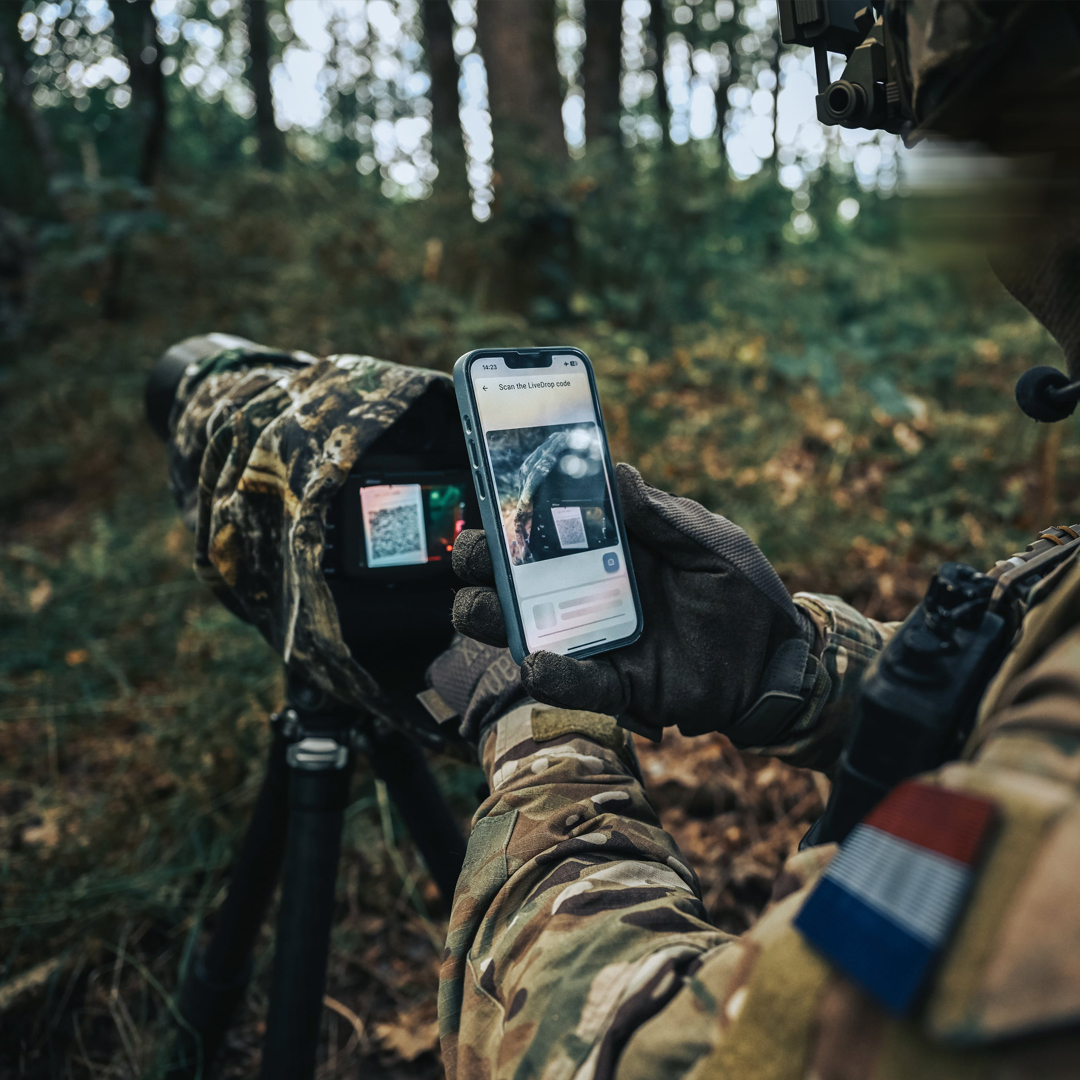
LiveDrop uses a different physical transport mechanism. Data is encrypted locally and transferred directly between devices using an optical, short-range physical-layer signaling method. The transfer does not depend on Wi-Fi, Bluetooth, NFC, cellular connectivity, IP routing or cloud infrastructure. The data is decrypted and processed locally at the receiving endpoint.
The approach has an inherent constraint: optical communication requires line-of-sight and proximity between endpoints. It is therefore not suitable for long-range communication and does not replace RF or SATCOM. Its technical relevance lies in providing a separate physical path for data exchange when conventional network connectivity is unavailable or deliberately avoided.
Under DDIL conditions, this can allow sensor data, imagery and other mission data to continue moving locally between disconnected systems. For example, data generated by a sensor or edge system can be physically transferred to another endpoint without requiring an operational network connection. Maintaining these local data flows can help preserve situational awareness, even when parts of the wider communications infrastructure are degraded or denied.
Technically, this introduces another transport mechanism into the communications architecture: optical, short-range, line-of-sight and independent of the conventional RF and IP transport layers.